
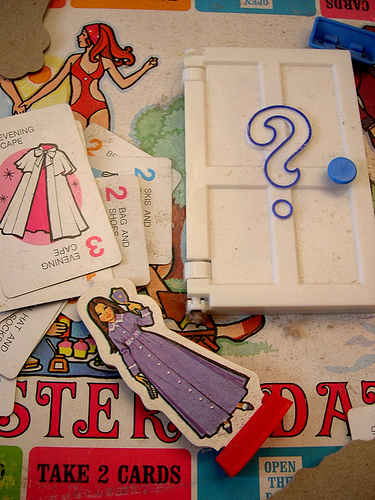
Open the Door for Your Mystery Date

Marketing specific toys exclusively to girls is nothing new, nor is it simply a retro relic. Toy sections of every toy store, Target and Walmart in the country are divided by pink/purple and blue/black. These days toy companies seem to be marketing virtually every toy or game in a “girl” version. Exhibit A. B. C. D. and E. No, these board games are not pink for breast cancer awareness and yes the sample word on that Scrabble box is “fashion.”
Happening upon these” girly” versions of classic games got me thinking about the girl’s games from my own youth, the slumber party classics: Girl Talk (The one which punishes players with sticker-zits, very exciting to any 7-year-old) Dreamphone (*in electronic dream-boy voice* “You’re right, I really like you!”) and the Godmother of them all: Mystery Date, a game who’s object is to gather accessories for a themed date in hopes that your themed dream-boat is the one behind that tiny door, waiting to take you out.
Mystery Date was created by the late Marvin Glass & Associates whose reputation still precedes them, the company’s atmosphere was described by a former employee as, “a cross between James Bond and the Playboy Mansion.” It was in 1965 that Marvin Glass premiered Mystery Date, a girls-only wish fulfillment game that was truly the first of it’s kind. Tim Walch, a toy designer and retro toy expert, said in an over-the-phone interview that the game’s set-up was probably inspired by 60’s television. “Lets make a deal was a big game show at the time, you know ‘let’s see whats behind door #1,’ I think that influenced the designers, as Mystery Date was the about not knowing who was behind the plastic door. It was like The Dating Game as well, with that mystery aspect” says Walch.
The game-play portion of Mystery Date doesn’t take more than a few seconds to get–collecting three pieces for a themed’ date and then getting together with the right boy for that date. “It was terribly simple, which leads me to believe that most of the good stuff was going on within the girls’ own heads” says Todd Frye, a retro game expert and founder of FeelingRetro.com, “While they played the game, they imagined themselves as having all of the opportunities for romance that their ‘game-selves’ got to enjoy” Frye adds.
Anyone who recalls playing these games at slumber parties can attest that it could get heated at times over who would snag the cardboard hunk. This then, is where the truly revolutionary part of the game comes into play: the game itself worked by harnessing the hormones of pre-teen girls and entered into the territory of romantic/sexual fantasy. “The cover of the box said ‘Meet your secret admirer’ which hits on the desire to be loved, this is your secret admirer, someone that likes you. It’s not just a date” Walch explains. If you were a child of the 80’s you may remember that this “Secret Admirer” shtick also was the tagline for DreamPhone.
In the toy industry, game makers know that girls mature faster than boys, which was another part of why Mystery Date was so successful. In 1965, 12-year-old girls were allowed to go on imaginary dream dates while boys still teased girls with the fear of catching cooties. Here was a game that was harnessing these pre-teen hormones in a safe way; girls were playing the game at slumber parties with each other, not actually going on on dates. Yet, Walch notes that while the girls on the box of Mystery Date appear to be petite teens, all of the “Mystery Dates” look about 25, like full grown men.
Mystery Date and DreamPhone are among the most expensive board games on Ebay; the games obviously struck a chord with girls and in turn have become a much sought-after nostalgia piece. But hovering in nostalgia may be where these “dating board games” remain. Girls-wish-fulfillment toys about emulating their mothers like EZ-Bake, babydolls and even Barbie with her many careers still remain hot items, yet Mystery Date and it’s 80’s and 90’s counterparts seemed to have dissapeared from the pink shelves.
While the pink and blue toy aisle segregation may be around for a while, Walch says toy makers are now marketing specific gender toys less and less. Rather than making a specific “girl” boardgames, it would seem toy designers just make half of the regular boardgames pink. That may still be offensive, however the days of girls games only centering around choosing what to wear and hoping that a special boy will call are now quaint relics for us to wax nostalgic over. While it may be tedious, perhaps this is not bad progress after all.
- Login or register to post comments
- Printer-friendly version
- 400 reads
- Send to friend
 PDF version












Comments
thanks, rabbit for this one.
It's a combination of joys for me. First, I get a reason to turn on the way-back machine and look for an old TV commercial from my youth.
Second, we get to enjoy more of your brilliance. Keep it up, g/f. You're onto something here.
-arvan